The Šolta parishes preserve a rich sacred heritage — from early Christian foundations to Baroque altars and votive paintings. Click on a church name for more information.
Parish Church of Saint Stephen the Protomartyr – Grohote
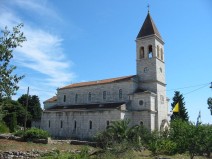
Construction of the Parish Church of Saint Stephen began in 1913 on the site of the old, demolished church. The First World War slowed its building, and regular liturgical services had certainly begun by 1927, even though the church was not yet fully completed. In 1938 the main altar, a work by sculptor Ante Frank of Split, was installed.
The church is an imposing structure with three naves. The façade features a bell tower with a prominent portal and an eight-pointed stone rose window, with a public clock below the bells. The bell tower is crowned with a slender pyramid and cross. Sacristies are placed on either side of the large semicircular apse; a collection of ecclesiastical artworks is arranged in the northern sacristy.
During the pastorate of Fr. Špiro Vuković (1975–1982) stained-glass windows were installed, and a mosaic depicting Croatian saints — a work by Fr. Ante Škobalj — was placed on the main altar. In the northern nave stands a Baroque altar of Our Lady of Mount Carmel from the old church. The church holds several objects of artistic value protected as movable cultural monuments, notably a painting of the Assumption of Our Lady by the Flemish painter Pieter de Coster (17th century) and a gilded reliquary from the 15th century.

Along the northern wall of today's parish church stand the conserved foundations of an early Christian basilica from the late 5th or early 6th century. According to Thomas the Archdeacon, it was burned by pirates from Omiš in 1241. The site was examined by experts in 1978 and protected as an immovable cultural monument by the Conservation Institute for Dalmatia in Split in 1962.
Church of Saint Michael – Grohote / Srednje Selo

The Church of Saint Michael stands at the edge of the field between Grohote and Srednje Selo. Built in the 14th century and decorated with frescoes whose remains are still visible today, it has a semicircular apse, a bell cote at the top of the façade, and is covered with stone slabs. The floor is also paved with stone. In the 19th century two arched windows were opened; the interior is vaulted with a broken Gothic vault.
The altar is raised on one step; its base is a stone monolith — likely a fragment of a sarcophagus serving as the stone mensa. The church stands on an ancient sacred site and is the oldest surviving church on the island, first mentioned in 1398. It is 7.15 m long and 4.85 m wide. Protected as a cultural monument. A cemetery for plague victims from across the island was once located beside it.
Church of Saint Teresa of Ávila – Rogač
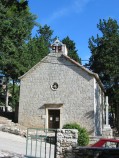
The Church of Saint Teresa of Ávila in Rogač was built in the 17th century. On the altar is a painting depicting Saint Teresa and the donor Nikola Gvozdenović (Ferro), who died in 1672; the painting was made in 1749. The church is 17 m long and 8 m wide.
It contains votive paintings of ships donated by sailors and sea captains, a painting of Our Lady of Sorrows, and the banner of Saint Nicholas bearing the inscription: "Croatian Society of St. Nicholas the Traveller, Chicago, 1913." The church also holds statues of Saint Teresa and Saint Nicholas. During the pastorate of Fr. Špiro Vuković a bell cote for two bells was added, along with a people's altar.
Parish Church of Saint John the Baptist – Gornje Selo
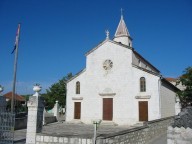
The Parish Church of Saint John the Baptist stands in the centre of the village. It was built on the site of an older church in 1859, financed by knight Marin Bavčević. The church is basilical in form with three naves. The façade has three doorways, two arched windows above the side-nave doors, and a large eight-pointed rose window on the raised central section. A stone statue of Saint John the Baptist crowns the façade. The church is built of dressed stone, with a sacristy on one side of the sanctuary and a bell tower on the other.
Inside are five marble altars. The main altar features a painting of the Baptism of Christ, flanked by statues of Saint John the Baptist and Saint Philip Neri. The side naves hold altars of the Sacred Heart and Our Lady of the Rosary, and altars of the Souls in Purgatory and the Holy Family. Wall niches contain statues of Saint Spyridon and Saint Anthony. In 1977 Fr. Ante Škobalj renovated the sanctuary and installed a stone people's altar.
The present church was built on the site of an earlier Church of Saint John, described in 1579 as "newly built" (nuperrime aedificata). That small chapel was built by the villagers because of the distance from the parish church of Saint Mary, and eventually became the parish church itself.
Church of Saint Mary in the Pines – Stomorija
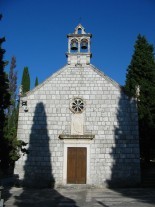
The church received its present appearance in 1776, built on the site of an older Benedictine church from the 13th century, which is believed to have stood on an even earlier pre-Romanesque church. The Romanesque apse from the Benedictine church survives; the sanctuary is Gothic in style, while the newest part — the nave — is Baroque.
On the altar is an old painting of Our Lady with the Child, a tempera on wood by a local master from the 15th–16th century. It bears a silver Baroque frame and was entered in the Register of Movable Cultural Monuments in 1963. It is believed to originate from the former Benedictine monastery. On either side of the sanctuary are statues of Our Lady of the Seven Sorrows and Our Lady of Health. The façade features an eight-pointed stone rose window; the top of the façade has a bell cote for two bells.
Church of Saint Nicholas – Stomorska
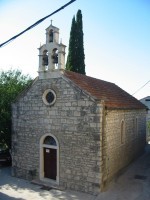
The Church of Saint Nicholas is located in Stomorska, the harbour of Gornje Selo. Stomorska was founded in the 17th century — the first two families were the Bučić-Vidan family, shipbuilders from Hvar, and the Novaković family from Tugare. The present church was built on the site of an earlier chapel in 1870. Above the façade is a bell cote for three bells. The church has a single altar dedicated to Saint Nicholas the Bishop, and Saint Teresa of Ávila is also venerated here. The church was renovated during the pastorate of Fr. Ante Škobalj.
Chapel of Our Lady of Health – Gornje Selo
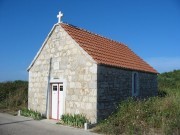
The Chapel of Our Lady of Health stands outside the village in the area known as Vinogradišća. It was built as a votive chapel by the Bavčević family in 1903. In 2003 the sons of the late Vicko Bavčević — Zlatan, Mladen and Dražen — restored it on the occasion of its centenary. The chapel was blessed by pastoral vicar of the archdiocese Mons. Drago Šimundža on 13 July 2003. Inside is a painting showing Our Lady with the Child, with Saint Peter the Apostle on her right and a bishop on her left. The people also call it Our Lady of the Fields and Our Lady of St. Peter's Day.
Chapel of Our Lady of the Rosary – Gornje Selo
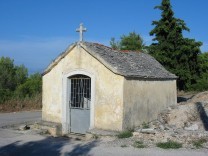
The Chapel of Our Lady of the Rosary stands outside the village in the area known as Križice. It was built in 1880, as inscribed on the stone cross at the top of the façade. The chapel is covered with stone slabs and contains a statue of Our Lady.
Parish Church of the Purification of the Blessed Virgin Mary – Srednje Selo
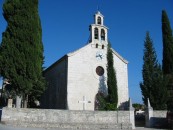
The Parish Church of the Purification of the Blessed Virgin Mary was built of dressed stone in 1882, during the pastorate of Fr. Nikola Šimić. The church is 21 m long and 7.5 m wide. The façade has arched doors with profiled jambs, a large round window in the centre, a public clock above it, and a bell cote for three bells at the top. The interior has three marble altars, the work of stonemason Pavao Bilinić of Split. The main altar features a painting of the Presentation of Jesus in the Temple by A. Zuccaro. A side altar holds a painting of Our Lady from the old church; the other, with a marble Crucifix, is dedicated to the Holy Cross.
In 1895 the sanctuary was paved with marble slabs. In 1909 the roof was renewed and the following year the interior, along with carved wooden statues of Our Lady, Saint Joseph and Saint Blaise — Tyrolean work. The church also holds paintings from the side altars of the old church: Saint George and Saint Christopher. The painting of Saint Christopher was made in 1812 by Fr. Alojzije Macanović, parish priest in Grohote.
The present church was built on the site of the old parish church, a vaulted structure 11 m long and 4.5 m wide. In 1579 it had two altars; a third was added during the 17th century. One chalice from the old church survives, bearing the year 1564.
Parish Church of Saint Martin the Bishop – Donje Selo
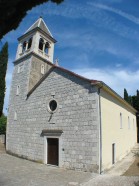
The oldest part of the church is behind the main altar, where the sacristy is now housed — this was the original chapel from the 14th century, which already had two altars in 1579: the main altar of Saint Martin and a side altar of Saint Catherine. A Renaissance tabernacle by an unknown local craftsman is set in a wall niche beside the main altar. An early Christian sarcophagus from the 6th century was used as the main altar.
The church was enlarged in 1685. Completion of the furnishings took considerable time, and the church was finally consecrated by Archbishop Bizza on 7 March 1750, as recorded in a carved inscription. Restored in 1902, it acquired its present appearance: a bell tower with biforate windows on the belfry level and a pyramidal cap, and five stone altars decorated with marble inlay. The main altar features a painting of the Virgin surrounded by angels and Saints Martin and John the Baptist — a work of the Flemish master Pieter de Coster (17th century). The church was renovated again in 1978, when a people's altar was installed.
Church of Saint Helena – Donje Selo
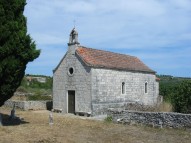
The Church of Saint Helena in its present form was built in the late 17th century, as documented in records from the time of Archbishop Cosmi. It is a single-nave stone building with a bell cote for one bell and a round stone window on the façade. Its walls incorporate ancient stone fragments. The altar here is also an early Christian sarcophagus with an incised cross in a circle. The holy water font inside the entrance was carved in 1746, as inscribed on the font itself.
The church was built on the foundations of a 6th-century early Christian basilica, of which parts of the walls are incorporated into the south and north walls of the present church, along with remains of the original floor and the early Christian sarcophagus reused as the altar. The Conservation Institute in Split entered it in the Register of Immovable Cultural Monuments in 1963.
Chapel of Our Lady of Lourdes – Srednje Selo
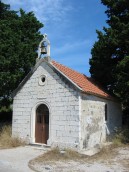
The Chapel of Our Lady of Lourdes was built of dressed stone in 1910. The entrance has a semicircular lintel and the windows are arched. The façade features a round stone window and a bell cote for one bell, added in 1979. The chapel is covered with a flat tile roof and contains a statue of Our Lady of Lourdes and the Stations of the Cross.
Parish Church of Saint Nicholas – Maslinica
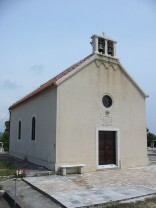
The Parish Church of Saint Nicholas stands on a hill south of the harbour. The present church was built in 1880 on the site of an earlier church from 1706, as recorded on a plaque with a Latin inscription above the entrance. The façade has a round window and a bell cote for two bells; the nave has two arched windows on each side.
During a storm in 1987, lightning struck the church and set it on fire. It was rebuilt during the pastorate of Fr. Jakiša Dominiković, and a new stone people's altar was installed in the sanctuary. The restored church was blessed by Archbishop Jurić on 20 August 1989.
Remains of an Early Christian Basilica – Stipanska Islet
Stipanska is the largest of seven islets off Maslinica, about 2 km away. The western part of the islet is called Mostir — probably after the remains of an old church and Benedictine monastery. From the surviving foundations it can be concluded that this was an early Christian basilica approximately 19 m long and 11.5 m wide — similar in form to the early Christian basilica in Grohote.
On the foundations of the early Christian basilica a church with a house was built in the Middle Ages, likely belonging to the Monastery of Saint Stephen in Split, which owned property on this islet and on Šolta. The church on the islet was probably also dedicated to Saint Stephen, and the islet took its name from it — Stipanska.
Chapel of Our Lady of the Gate of Dawn – Nečujam
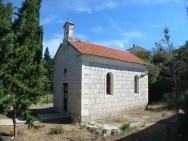
The Chapel of Our Lady of the Gate of Dawn in Nečujam was built of finely dressed stone in 1938 by the Bartelmus family from Poland. The altar is made of oak and the image of Our Lady is framed in gilded brass. The Polish inscription reads: "We fly to your protection — Ema and Jozef Bartelmus." The chapel is 9 × 4 m, covered with a flat tile roof, and has a bell cote for one bell at the top of the façade.
The remains of the apse of the old Church of Saint Peter are still visible in Nečujam today. That church was built in the 14th century and its remains were protected as a cultural monument in 1963. Beside it stand the ruins of the building where Marko Marulić, the Croatian Renaissance writer, stayed, reflected and wrote.